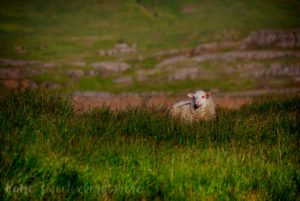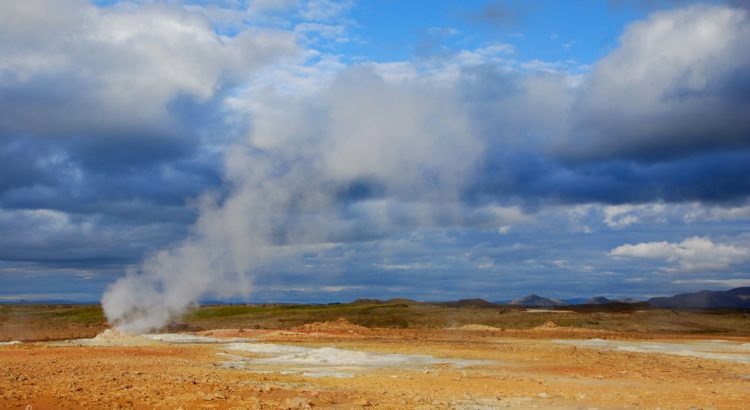
Heading further west along the northern part of Iceland, the land changes from grey to rolling burnt orange, yellow, and grey. This is Iceland’s active volcano region where the earth occasionally bubbles and explodes in plumes of smoke. The air smells like boiled egg. Some might say it reeks, this stench, but this smell has never bothered me. It brings back memories of living in Japan and soaking in onsen, and the pleasure of having my own private onsen when I Wwoofed in Kyushu. I welcome the smell.
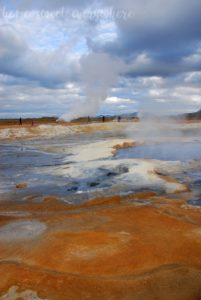
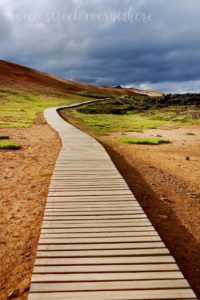
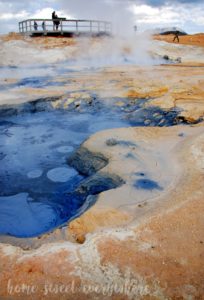
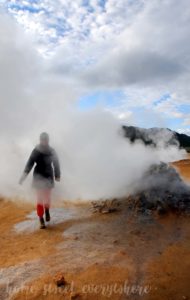
There are two notable walks that take interested viewers close to the bubbling muds. The first is a short drive past the geothermal power station to Krafla, which is in itself a stunning sight, the neat tubes running around the grounds, some of them steaming. The second, just off Route 1, is Hverir. Neither is difficult to miss: the smell and the plumes of smoke are clear markers.
My ideas about the cosmos expand. This is a landscape that doesn’t come from science fiction, or someone’s imagination. It is real, and I am standing on it. Surrounded by smoke. Sulphuric mist fogs up my glasses.
The bubbling of the grey mud is ominous. Don’t mess with me, human. Respect me and you just might be fine.
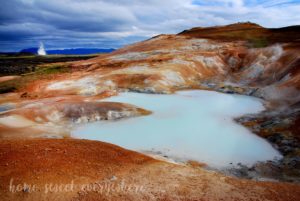
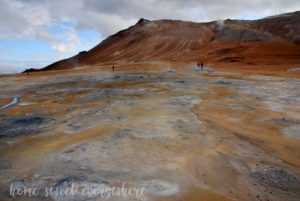
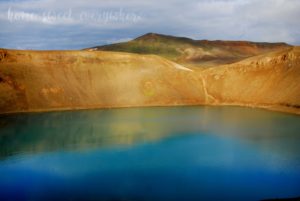
There is a geysir whose steam is being directed towards the ground. It’s great fun to stride through it. Though smelly, the steam is supposed to be very good for your skin. Free spa. Yes, please.
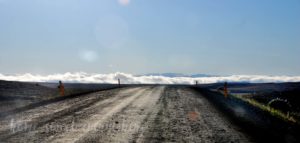
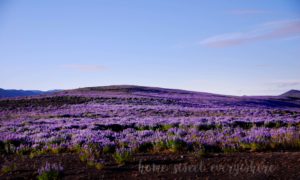
It’s late by the time we’re driving up Rte. 87, the gravel road that’s like a seesaw, dipping in and out of the valley, above the clouds gathering to meet the sunset. Fields of Alaskan Lupine (not native to Iceland) densely carpet the floor on either side of the road. With the sun shining, it feels like we’re driving along a yellow brick road towards paradise.
At the campground a lovely young Icelander takes our details. He’s interested in knowing where we are from. We boast about Iceland’s beauty and how incredible it is to be here.
“I’ve lived here all of my 20 years. To me, this isn’t interesting. This is my life everyday,” he tells us. There’s no humour in his voice.
Yes, isn’t that the truth. I am always running away from my current abode in Canada to explore other places, but really, Canada is stunning. Still, exploring these new landscapes and meeting new people is incredible, and I always have a difficult time returning home to my apartment, my job, and my routine. I’m usually counting down until the next opportunity to be away.
I assure the young man that it’s beautiful everywhere, and we encourage him to go on a jaunt around the world for a little while. It will make him appreciate the majestic beauty of his home.
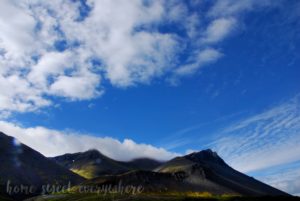
As per usual, the next morning is cold and misty. It’s very cold, actually, but thankfully our campground is pretty lush and has an indoor space that’s a lot like a living room, with couches, plug sockets and warmth. The morning starts here as the tent dries off a little before it’s stowed away in the car: the car is starting to get a musty smell from the constantly damp tent that sits in the back and dries before it’s set up again.
Most people probably associate Iceland with Blue Lagoon’s blue soaking waters, but on our drive back to Rte. 1 we stop at Mývatn Nature Baths. It’s a cold, gloomy morning, and I’m keen to be warm.
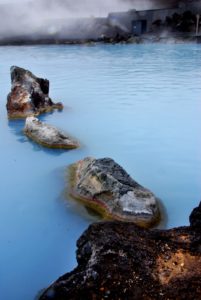
It’s not sunny when I step into the water. In fact, when the glass doors open out into the outdoors and the chilly wind hits my wet body, I’m stunned. The guard who sits outside is layered, only her head peeks out of her winter attire; meanwhile, in my bathing suit, I’m clumsily making my way down some steep steps, and a slippery incline into the water.
As soon as my toe meets the hot, milky water, the blast of cold is worth it.
It’s early, just gone 10:30am, and drizzly, so there are very few people in the pools. It’s quiet, cozy and luxurious, and there are plenty of places to perch on a hot rock or bench in the water and relax. The water isn’t a lush blue like the in promotion photographs for Blue Lagoon, but it probably would be if the sun was out. I’m lounging in pleasant, chalky grey coloured water, and happy. Now the cool air and drizzle is refreshing. An added bonus is that the Mývatn Nature Bath are cheaper than Blue Lagoon and you do not need to buy tickets in advance.
For 2 hours I hop between the big pool which sits around 37C, the hot pool which is about 42C, and the steam room. By noon, the baths are busier: it’s time to go.
Thankfully, we spend the rest of our day in the sun.
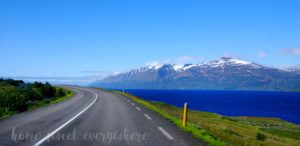
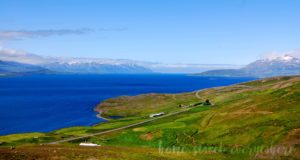
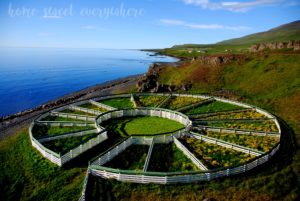
Our drive continues around Lake Mývatn before returning to Rte. 1 and then detouring to drive along the shores of Trollaskagi (Troll Peninsula). In the evening we wander around the town of Dalvik, hike up a ski hill, hold our breath as we pass the fishy harbour, and pop into a cafe for a delicious bowl of fish stew, served with a variety of home-baked breads. That night we watch the sun set, slowly. At 23,18 when I’m crawling into my sleeping bag the sky’s still blue and the inside of the tent lit up.
The next day is rainy and we’re chasing the clouds. We hike when a walking path beckons and put up our tent in a brief moment the rain stops.
The road from the campground in Varmaland leads to a swimming pool.
There may not be too many public washrooms or restaurants once you leave Reykjavik, but Iceland is full of public swimming pools, all warmed by the geothermal power of the earth. It’s strange to be in a warm pool, outside, under a grey cloud that hangs low over my head. This isn’t the kind of weather I’d normally visit an outdoor pool. I can imagine how amazing it would be in winter. The pool also has a hot tub. Toasty.
It’s not long before we are driving back through Borgarnes, along the foot of Hafnarfjall mountain, passing Reykjavik and handing back the car keys. Jimny served us well.
A hostel is our home for the last two days of the trip. It is full of people from all over the world (Chile, Canada, England, Argentina, to name a few), who are either about to start their journeys or have just finished. Together they stand in front of a big map of Iceland. The travellers that have just finished their trips hand out free tips to the newbies who listen intently and ask lots of questions. There are plenty of stories about the weather, Iceland’s main obstacle, particularly in the high country where snow still covers the ground. The other seems to be the uncertainty of how long a hitchhiker might have to wait to be picked up: the waiting time seems to be 2 to 6 hours. I listen to these hikers and dream of returning to Iceland but ditching the car in order to hike its wilderness. I’ll be well prepared for the weather.