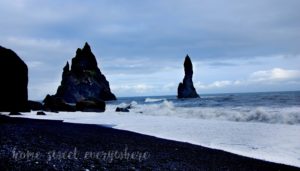
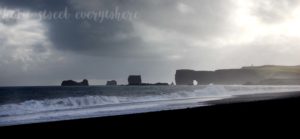
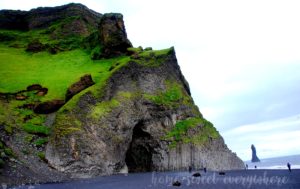
Just east of Vik is the incredible Reynisfjall, a massive ridge rising high from the sea’s edge, stacked in hexagonal basalt columns, grazed at its bottom by a black beach. The pebbles on the beach are edgy, sharp and heavy. They shine beautifully in the sun. Standing at the beach and looking west, we see Dyrholaey, a huge rocky plateau that juts out into the sea. The sea has crashed into in and made gates from the sea to flow freely under its arches. It’s easy to see, standing here, why Iceland is one of the filming locations for Game of Thrones, though this isn’t one of their locations. It could be.
We have a long day of driving before we make our next campground, made longer by the many stops we have to make along the way. Setting out early, I know of three stops that we’ll definitely have to make, but I can’t predict how many other stops we’ll encounter and not be able to simply drive by.
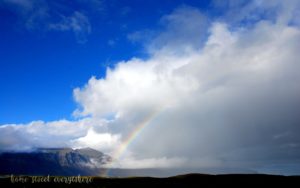
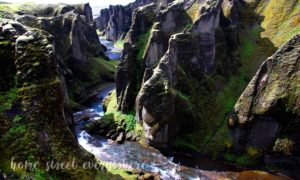
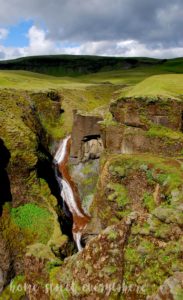
It’s always good to start the morning off with a hike. We get up early, take Route 1 and then detour on Rte. 206 to get to Fjaðrárgljúfur Canyon. It’s impressive to see the power that water has on shaping, carving and smoothing rock. A path leads alongside the edge of the canyon from which we look down into the crevices, nooks and crannies forged by the water that’s speeding to spill out into the ocean, which is also visible from the path. Of course, there are more waterfalls; thankfully, it’s a sunny morning so more rainbows sparkle and brighten our morning.
It’s not a long drive before our next stop, Núpsstaður Farm. Sadly, I can not remember when it was last farmed, but it stands abandoned now, with a few paths leading around the property. We leave our car on the side of the road, cross the fence and wander in, imaginations turned on to see what life would have been like here, in this isolated part of Iceland, in the winter, in a time before the Ring Road.
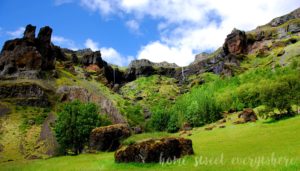
The backdrop is amazing. The farm lies on an incline, and behind it rises a massive cliff, Lómagnúpur, from which there is, yes, water falling down to into a creek.
The farm is dotted with a few traditional Icelandic turf buildings. The roofs are covered in grass and moss, the buildings themselves are set deep into the earth. From far away, the farm is camouflaged by green, only windows and doors peeking out of the earth. There is also a quaint turf chapel. We wander in. It’s tiny, perhaps it fits 4 people, and they likely have to stoop, as we do. Into the altar is engraved the date, 1789.
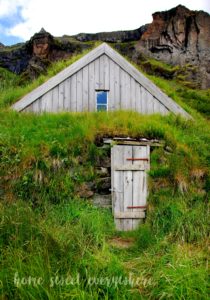
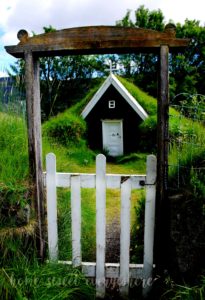
It’s incredible to imagine that people lived here, woke up every morning to these scenes, and farmed a land that doesn’t seem like it would like to be turned by the hands of man and tools. The looming Lómagnúpur that lies behind it would have wanted to protect the land, I’m certain. Still, people came.
Because I’m in Iceland, I’m reading, Independent People by Halldór Laxness, in which the main character, Bjartur, strives for independence, to own land and work the earth so that it provides for him and his family. The land is harsh, the weather harsher, yet still, he perseveres. Iceland teaches us a lot about the will of the human spirit, and that will can easily be imagined at work here.
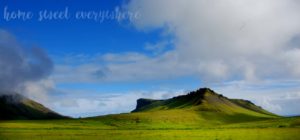
The road continues, flat. The sea is flat as it meets Iceland’s southern shores; behind you, in front of you, to the left is…flat. I can’t believe that Iceland has so many kilometers of flat space. The glaciers ravaged the earth flat on their descent, scraping the earth, shaving it clean. Lava spilled over the land, cooled and left it flatter. The drive, though it seems rather long and feels as if we’re not getting anywhere for an hour or so, is beautiful. The flat lands are covered in Alaskan lupine, a vibrant purple flower that carpets the earth. It’s like a scene from Alice In Wonderland – I’ve been shrunk and dropped into serenity, a world where everything is bigger, smaller, stranger.
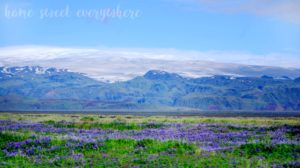
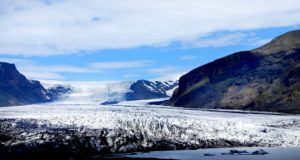
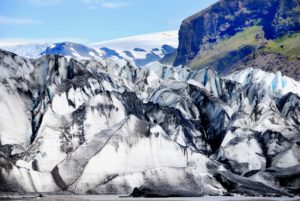
Soon enough, the earth starts rising; we are driving towards Vatnajokull National Park and Skaftafell. The glacier, Skaftafellsjökull, that hangs onto the mountains can be seen from afar; once we get to the park, we hike towards it, and the closer we get, the colder it gets. By the time we stand at the river’s edge, the glacier’s fingers dipping into the river not very far away, my wooly hat is on, my nose is red and my hands are in my pockets frozen from holding the camera to take photos.
The other sight to see here is the Svartifoss, an impressive fall of water over black basalt columns, but we don’t have the time. We have to get to the glacier lagoons.
The first glacier lagoon we visit is Fjallsárlón. Tour buses don’t stop here because this lagoon is smaller, and the floating icebergs are smaller and fewer, but it is still very impressive. The lack of visitors means that we can sit by the lagoon’s edge and listen to the crackle of the thousand year old ice melting as it floats towards the sea. One of the icebergs even does a flip over, revealing its sparkly underside before it does another flop into the water.
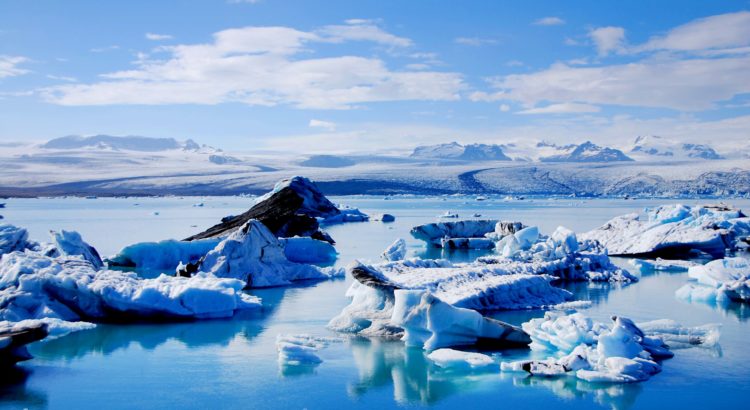
Jökulsárlón is the touristy glacier lagoon, but car parks dotted on the southern edge of the lagoon so it’s easy to avoid the packs of tour buses that commune at the main car park. We park far away from the tourist swamp, and slowly hike along the lagoon to eventually get to the masses of tour buses and people (that’s where the restrooms are.)
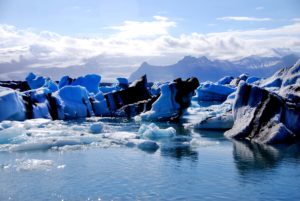
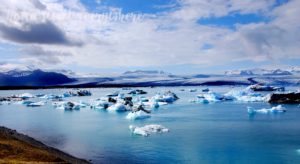
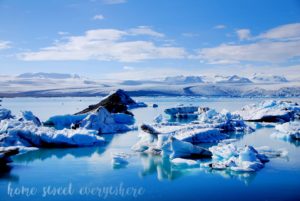
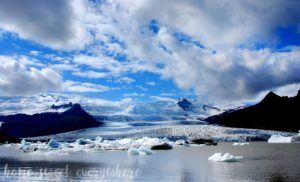
The icebergs here are impressive. In the sunlight, everything is a startling blue. It’s magical. Surreal. When the sun shines, everything glitters, but at the same time, everything is rather still; it takes years for an iceberg to make its way across the lagoon. We’re lucky enough to watch as an iceberg cracks, its smaller half crashing in the water, rolling over and bobbing along in the lagoon.
Stomach aching for some warm food, we drive into Höfn where Hafnarbuðin, a tiny diner by the harbour’s edge serves fish’n’chips, burgers and other fast food meals for very reasonable Icelandic prices. Our meals arrive and they are huge. The fresh fish fillets are thick and moist, but crispy on the outside. In fact, the two fillets we each get are too much, so we save one fillet each – this, packed into a fresh bun the next day, makes for an excellent lunch.
Stomach full, our bodies re-energized and warm, we set off again, entering east Iceland’s fjord country. Route 1 sticks to the jagged coast, then veers off north towards the highlands, but we stay on the coast, taking Rte. 96 to get to our campground. The road is long and windy, the fjords are very deep. Rarely do we spot another vehicle. Looking at the map, the distance travelled isn’t very much, but there is a lot of road. A few tunnels and we’re at our next campground in Reyðarfjörður.