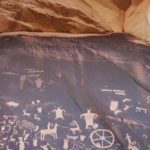
Canyonlands National Park has 4 districts, all of which are far drives from one another, and my first stop is the Needles Visitor Centre. When I arrive I wonder if I’m lost: I don’t see a line of cars at the entrance; HWY 211 that brings me here is likewise abandoned – I only pass one car on my drive from Monticello, and Monticello itself, when I leave, is still sleepy. I only see a few people at Newspaper Rock, to read the hieroglyphs.
The rangers at the Visitors Centre tell me that this is the quiet time of the year – the heat keeps people away. When I ask about hikes, the first thing the ranger does is cross out a huge section of the map, citing the heat and strenuous nature of the hikes do not play well on a day like today. She says this with such gumption that I am afraid to defy her.
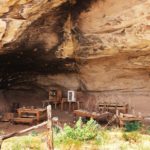
Thankfully, National Parks in the States are made for both hikers and people who like to do the stereotypical drives through and see the best scenic spots, so I hit the road, windows open wide. I do get out and hike the various 1km to 4km walks along the way to break up the drive, but I hear the ranger’s voice and do not attempt anything longer. One of the hikes has a small exhibit of a camp set up by some ranchers, safe under a rock’s alcove.
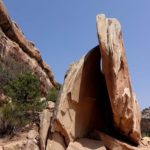
The Slick Rock hike is the most fun. I love a hike that makes me feel like a kid as I jump from rock to rock and do a bit of climbing to stand at the edge of vast canyons carved out by water. The area is in high drought, and I neither see nor smell water. All there is to see are the waves carved into the rock, jagged and smooth, rough and round, colourful layers of history to remind me how little I am, how young, in comparison to rock on which I stand.
Can we live as long as this rock? Will the environment shape us, or will we shape our environment? These thoughts fill my head as I sit in a shady spot, feet hanging off the edge. Here, I am small and insignificant; I like the feeling.
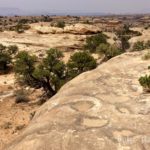
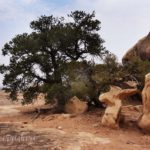
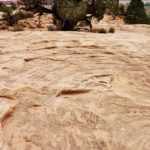
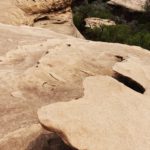
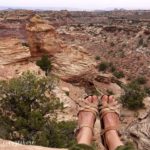
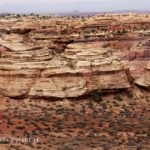
Slick Rock is also the hike that I get a lost on. At some point I lose the trail of cairns. I try to retrace my steps, look for footprints in the bits of sand piles, and stand still, staring, hoping to see a cairn. I’m not lost long, but without a phone signal or other hikers on the trial, my mind does play out various scenarios of how I would have to survive, were I forced to.
I drink and drink and drink. Water, of course, though other cool beverages are sometimes enjoyed in the evening. I’ve never had such cravings for water; water has never tasted so sweet. Roughly counting the number of refills of my water containers, I estimate that I am drinking 3.5L of water per day, not counting the water in my coffee, kiwis, apples and other foods I consume.
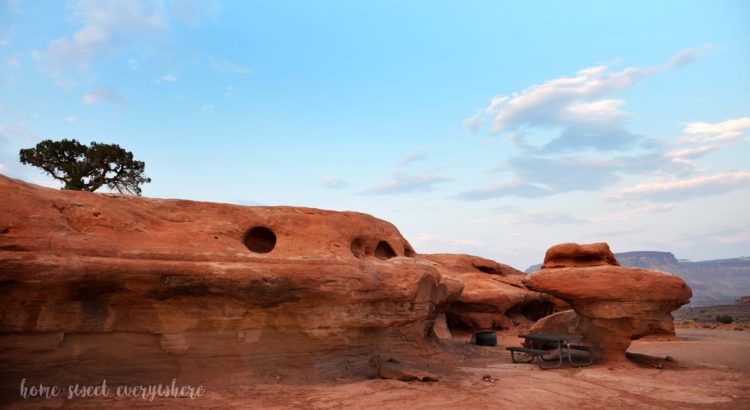
I camp about 7 miles east of the park at Hamburger Rock, a BLM ran campground, which means, usually, no water, no trash, and a pot-hole toilet, but for the price and location of these sites, it is worth it. You can always have a cowboy shower if one is needed, after all, and in the heat of the summer, you get to have your pick of sites.
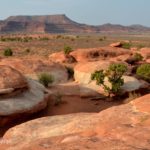
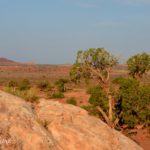
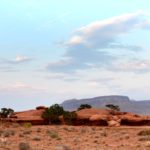
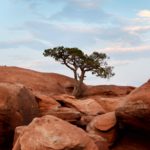
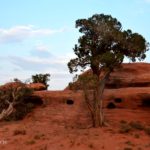
Hamburger Rock is incredible. I have no idea why it’s called Hamburger Rock, but I suspect it is because the rock looks like a hamburger that’s spilling over the edges of a soggy bun. The campsites are tucked in under this dripping rock, in small alcoves. Surrounding the rock are miles of flat, red valley.
The campground is deserted. I see only one set of tire tracks, and footprints that circle one site then disappear. I am alone. Cars don’t even drive down the gravel road that goes on past the site. I see and hear no vehicles or people.
After my initial excitement passes, I become dubious – how safe is it for me to be here, alone, without service, not really knowing where I am? Isn’t it safer to be, for the night, at a site where there are some people, even if they’re strangers? If something does happen, can I (a) run away from a crazy person, (b) run to my car, and outdrive a crazy person in what will likely be a 4WD pick-up, (c) find some kind of weapon to fight a crazy person?
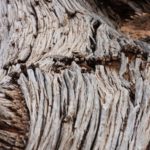
But, the site is too beautiful to leave. The rock is easy is climb, so like a child, with a sheepish smile, I explore. I climb the rock, squeeze through its crevices and into alcoves, examine the bark of trees, scare a rabbit, and find many lizards, most of whom stop to let me have a good look at them as they extend their necks and pose in the sun. I am aware that I have to climb with caution. If I fall and can’t drive, it may be some time before someone finds me.
I watch the sunset from the top of the hamburger, even though it is mostly obscured by cloud.
The night is dark. The moon and stars are hidden behind clouds, and suddenly, the quiet feels heavy; I am still the only one here. No phone reception. No people. No running water. I don’t know where the closest human is; probably 7 miles West at the National Park, which suddenly seems an awful long way away. Sometimes the breeze blows and there is the creak of a juniper tree or the rustle of my tent, too loud for comfort. Each sound is magnified. I can’t believe I am here, all alone. Now I hope that no other person arrives because, I wonder, who would they be?
I sit on my camping chair, all lights turned off. It’s just me and the land. If mum knew, she’d yell; she’d be upset and scared.
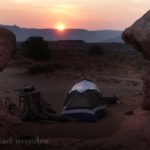
I sleep with the tent’s fly off, and see the stars as they come out. Suddenly, the moon is above, illuminating. It’s the hottest night so far, even humid. Everything is still; even the air hangs heavy, joined by the silence. It is so quiet, that my heartbeat is loud. I wonder at the truth of the oxymoron ‘deafening silence.’ It almost hurts. I have to admit that I am a little afraid, lying on my mat, looking up at the stars, but also listening for any sounds. It is a long time before I fall asleep. It isn’t a deep sleep – I toss and turn, the loud beat of my heart never quite quieting.
I’m awake to see the sunrise paint the rock golden. It’s beautiful. Now, in the the light, I am again happy to be here completely alone. I take my time leaving.