There are images of Utah everywhere. National Geographic. Calendars. Instagram. Computer wallpapers and screensavers. In films. In literature. So, it’s been on my mind for a while to visit, and I’m eager to see it in real life. On the way, I have to explore Colorado, too.
Because I think I can, I decide to drive 2,434km in two days to get to Colorado’s Rocky Mountain National Park. Getting up early, and driving to the border in Sarnia, Ontario is easy. I’m excited, caffeinated and the big blue line of the I-80 in my atlas, that spans pages, doesn’t phase me.
The state lines pass by quickly.
Welcome to Michigan. To Indiana. To Illinois. To Iowa.
I’m crushing it. I flip the pages of my atlas when I get to the rest stops, where I also snack and stretch my legs. I feels good to eating all these kilometers.
Mid-Iowa, I start to falter. My body starts to ache. I don’t like cruise control, there are too many lorries on the road to overtake to keep the car driving at a steady speed, and my heel begins to throb. My leg muscles twitch, my neck aches, my back is stiff, and my ass is numb.
Still, the sun has not gone down, and I push on, thinking that teaching is easier than being a transport truck driver. On the road, you always have to be completely alert or you may die, or worse yet, hurt or kill someone and live with the pain of that.
Nebraska welcomes me.
I pass by several campgrounds, but refuse to give in. To keep me company I have Tina Fey’s “Bossypants,” peppy country tunes on the radio, and NPR programming. I swap between the three.
As the sun sets my body admits defeat. I make it to Lincoln, Nebraska, having driven 1,632km. I vow never to eat that many kilometers again, but it does feel good knowing that my drive tomorrow will be shorter. I crawl into my tent and fall asleep.
Still, the next day’s drive is very long, despite it being shorter. At least, as I drive the I-80 through Nebraska, I’ve got the pungent reek of cattle farms to help keep me alert.
As soon as I cross the border into Colorado the scenery changes. The land becomes uneven, beige, and the land begins to rise.
I see mountains. My heart quickens, and I press on the accelerator to see how close I can get to them before the sun sets.
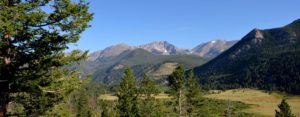
Suddenly, the mountains sprout out of the land and the road twists and turns. After 2500 km of straight road, this feels a little scary. All of a sudden I have to really pay attention. There are blind corners, rock on one side and a drop to the quick moving river on the other. The sun slips behind the mountain, and I still have my prescription sunglasses on. My knees are too wobbly, my ass aches, my eyes burn, my mind is tired. I’m at the point of even turning into a motel, but the few lodges along the way are all adorned with no vacancy signs.
I start to worry and make a list of the places I could sleep. The car, of course, is on the list. I pass a sigh for the Estes Park’s city limit and as the road turns right I see a KOA. I break sharply to make the turn. The office is closed so self register in one of the 3 remaining tent sites that are unoccupied. I put my name on an envelope. I can’t find the price at night and I’m glad…it would have hurt to sleep near a busy road on a gravel lot knowing that I am paying $54.
The morning is unexpectedly cold. My fingers and toes freeze as I load my tent into the back seat but I’m too eager to get to Rocky Mountain National Park to take the time to change out of my sandals.
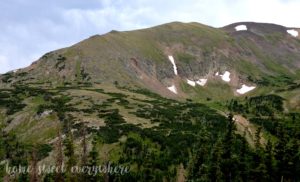
Having read that the Long Peaks campsite is the most popular and its perimeter dotted with parked cars, I head straight for the west side of Rocky Mountain National Park where there is a larger first-come-first-served campground without shade and far from the main attractions.
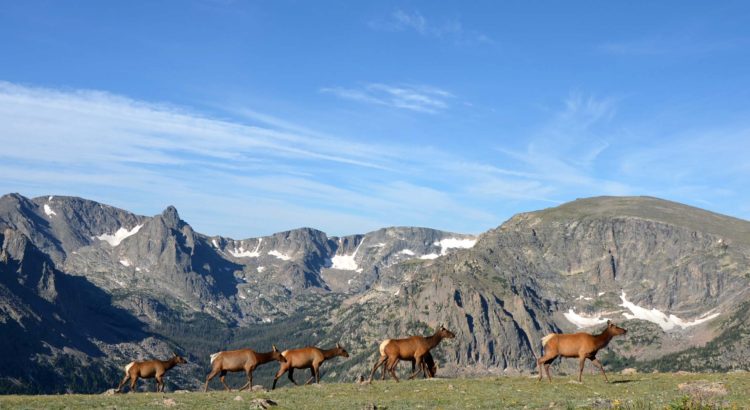
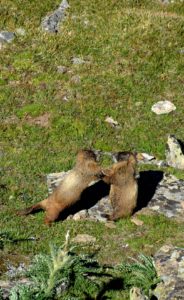
Driving along ridge road in one go is difficult – without thinking, I pull into the pullouts, getting out of the car, mouth wide open, looking at the earth. Even before I get to Timber Creek Campground I see gophers, marmots, and a group of elk that are grazing on the campground.
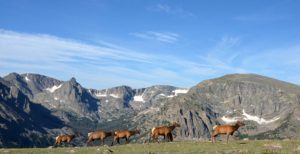
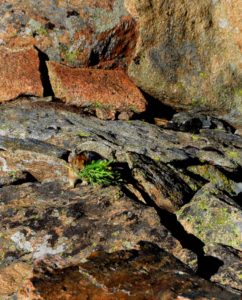
I climb into the tent, and lie down, leaving the flaps open so that the breeze has a way to enter – it is only 11am, but the driving has depleted my energy. 20 minutes later I awake, layered in a blanket of sweat.
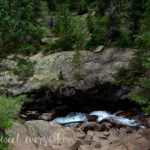
The ranger has highlighted some walks that aren’t as popular, and I begin my adventure walking along the Colorado River to the site of Lulu City, a population of 200 at a time when people were here to mine. Nothing remains now bar the trail and a cleared out lot.
In the bushes I spot a hammock with two feet hanging out of it. Someone has had a wonderful idea. I find a space on the river bank and sit and listen and relax.
Back at camp I have to force myself to eat – my body is on strike after the driving stint, and I’ve probably got a bit of altitude sickness. My meal is measly and my mum would scoff in disappointment: garlic and spinach, with a toasted bun I’d rubbed with garlic (I intend to get a lot of energy from the spinach – I can’t have another lazy day tomorrow – Colorado is waiting.)
I am in my tent at 9pm with the intention to read, but as soon as I’ve zipped up my sleeping bag, I don’t have the energy to put my headlight on to read.
In the morning, an elk’s call is better than an alarm. Hearing their hoofs right next to the tent as they pass my site, from the meadow and across the campground to their morning grazing grounds, is quite a pleasant way to be awoken; far more gentle than an alarm.
An elk is so close to the tent I can hear its teeth grinding on greens, the saliva’s enzymes hard at work. I am awake, but I lay still not wanting to startle the animals. I lie and listen, excited to be away from the concrete and glass cities, and in the middle of this morning ritual.
Other campers are quick to wake up. Not just because of the elk – the parking at trailheads here are precious finds past 10 am, besides, it’s not a great idea to be hiking in high altitude in the mid-day, so everyone is up, eating their breakfasts, lacing up their hiking boots and preparing water for the hikes.
The morning hike makes my heart pound, and I wonder if I am not as fit as I thought I was, but of course, it is the lack of oxygen. I have to slow down and adjust my hiking pace. Part of the reason why I was so loopy yesterday must have been altitude sickness, after all, I didn’t take any time to take it easy. Drove here and ran right into the forest.
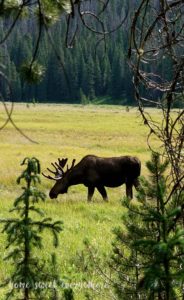
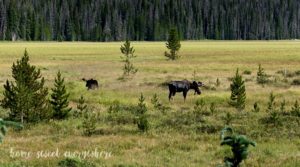
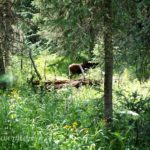
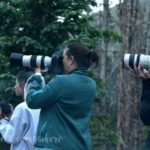
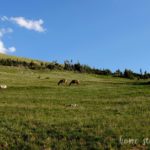
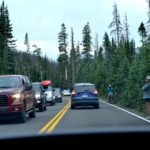
At a meadow a group of hikers is gathered, quiet. They are spying on 3 male and 1 female elk, partly covered in the tall grasses of the meadow. Some hikers have massive lenses, but I snap some good-enough shots with my little camera, and I’m off. RMNP is full of wildlife, and one doesn’t have to wander far to spot it. Several times I’m stopped in traffic as people pull over to see elk. Another time on a hike I’m startled by a moose. She’s with a calf, in the dense bush, feeding. There are marmots, gophers, squirrels and chipmunks. There are birds, but sadly I do not know anything about identifying bird species.
After a day of hiking I am tired, hot, but happy. I am back to myself, the fresh air and hike restoring my spirits and energy; the pains of the drive slip away into the nostalgia of a long drive that I think I can certainly do again, though I went to bed yesterday vowing not to do such long drives again.
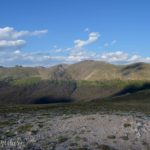
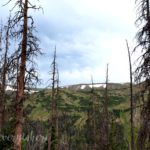
I spend the rest of the day avoiding the busy parts of the park, saving the one-way, narrow gravel mountain pass, Old Fall River Road, for the end. The ranger assures me he’s done it in his Civic. The road is steep. After a few hairpin switchbacks it’s cool to look down and see the snaking road below. There’s mountain on one side, a drop on the other, mountains in the distance, and the road ahead. Marvellous.
One thought to “A long drive and Rocky Mountain National Park”